Why doesn't ChatGPT mention my business? 8 things to check when AI assistants skip you
ChatGPT and other AI assistants may skip your business for more than one reason: the questions tested may not match how customers ask, your site may not clearly say what you offer and where, the websites the answers rely on may not list you, or the result may vary between checks. The eight checks below help you find which of these applies to you.

In short
- Not being named is common: in most checks in our sample, the business was named in no answer at all.
- Start with the questions: test what customers ask, with the place written in, before changing anything else.
- Start with the websites cited in your own answers, rather than generic lists of directories.
- Check who is named instead; that can show how the assistants interpret your category.
- Use repeated checks with the same questions, because results can vary between rounds.
On this page
- First: not being named is common
- 1. The questions you test aren't the ones customers ask
- 2. Your site doesn't clearly say what you offer, where you work and who you serve
- 3. The assistant doesn't connect your name to your category
- 4. The place is missing from the question
- 5. The websites the answers cite don't mention you
- 6. Look at who is named instead
- 7. Search visibility is one signal
- 8. One check can mislead, especially for new or niche businesses
- Where to start
If ChatGPT, Gemini, Copilot or Google AI Mode don't mention your business, several things could explain it: your test questions may not match what customers ask, your own site doesn't clearly say what you offer and where, the assistant doesn't connect your name to your category, or websites cited in the answers don't list you. Sometimes it is simply variation, and a second check looks different.
Below are eight things to check, in a sensible order. Each one says what you can look at and what CheckAI or our data can show about it. Where something is general advice rather than something we measured, it is labelled as advice.
First: not being named is common
Our data Across the checks run on CheckAI so far, the checked business was named in 36 of 709 answers (5.1%). In 18 of 31 checks it was named in no answer at all, and in only 1 check did all four assistants name the business.
- 5.1%of 709 answers named the checked business
- 18 of 31checks in which the business was not named
- 1 of 31checks in which all four assistants named the business
So a result of zero is a starting point, not a sign that something is broken. The useful question is which of the following applies to you.
1. The questions you test aren't the ones customers ask
Many owners test with their own business name ("What do you know about Velo Muster Bern?"). That tells you whether the assistant knows you, not whether it suggests you to a stranger. A customer asks about a need: "Where can I get my e-bike serviced in Bern this week?"
The type of question matters too. In CheckAI's setup we point out that pure cost or how-to questions often return no business names at all, and that a question naming a competitor tends to produce an answer that mostly compares with that competitor.
What to check (advice): write 5 to 10 questions as your customers would ask them, covering a general need, price, trust and urgency, and leave your name out. The guide on how to check if ChatGPT recommends your business walks through this.
2. Your site doesn't clearly say what you offer, where you work and who you serve
A clear description of what you do can help an assistant connect your business to a question. A homepage that says "We make it happen" without saying "bicycle repair and e-bike service in Bern" gives it little to work with.
There is a simple test built into CheckAI: it reads your homepage and drafts the customer questions from it. If the drafted questions describe the wrong offering or customers, or omit your location, that suggests your homepage doesn't state these things plainly. You can correct the questions, but the hint about your site remains.
What to check (advice): does your homepage say in plain words what you offer, where, and for whom, near the top and in text rather than only in images? Would a stranger understand it in ten seconds?
3. The assistant doesn't connect your name to your category
Some names are hard to place. A tax adviser in Munich called "Horizon" probably shares the name with other companies. A brand that shares its name with an open-source product or a widely sold device may be mentioned often, but as the other thing.
For counting, CheckAI matches your business name, any other names you give, and your domain. A shortened name that is also the name of a widely available product (for example the product name without your category word) is not counted as your business, and neither is a parent company or another product. That helps avoid false matches, but a mention of the shared name alone will not count in CheckAI.
What to check (advice): read the full answers where your name or a similar one appears. Is it about you or about something else? If your name is ambiguous, check that your site and your listings consistently pair the name with what you do and where, for example "Horizon, tax adviser in Munich".
4. The place is missing from the question
For a local business, the location in the question can affect who gets named. In CheckAI's setup only Google AI Mode accepts a country setting. ChatGPT, Gemini and Copilot get no location from us, so without the place in the question their answers can refer to another country. A question like "Which bike shop do you recommend?" without a town can return businesses on another continent.
What to check (advice): make sure every location-dependent question names the town, district or region. If you test by hand while logged in, your account or browser location may also shape the answer. A private window can avoid account-based personalization if you stay logged out, but it will not hide your location from the website.
5. The websites the answers cite don't mention you
Many answers include links to websites. If those pages list other businesses and not yours, compare those listings with the names in the answer. We can show which websites were cited; we can't show why a business was named.
Our data Across all checks, answers cited 3,044 links to 1,264 different websites, counted once per answer. 60% of those websites were cited only once. By type (editorial and other includes unclassified websites):
Because most websites appear only once across the whole sample, a generic list of "directories to be listed on" is a weak guide. Start with the websites cited in the answers to your questions. Note also that the assistants differ: in our data ChatGPT and Copilot included at least one source link in every answer, Gemini in about 30% of answers.
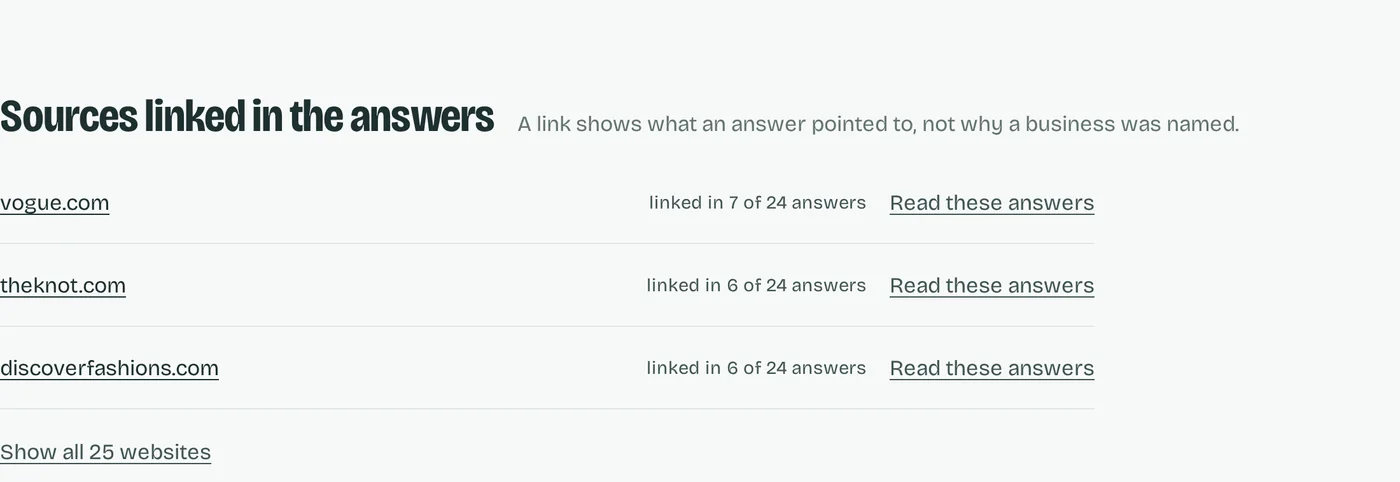
What to check (advice): open the most-cited pages from your own answers. Is your business listed there? Is the information correct? Could it reasonably be listed, for example as a local business in a city guide or a tool in a comparison article? Those pages may be worth contacting about a listing or correction.
6. Look at who is named instead
The other businesses named in the answers can show how the assistants interpret your questions. Sometimes they are your direct competitors. (Industry tests such as bike shops and accountants list every business named.) Sometimes they are large platforms, publications or tools from a neighboring category, which may mean the assistants interpreted your questions differently from what you intended.
Our data Across the four assistants, a single question produced a median of 17 different business names. Only 35 of 167 questions answered by all four had at least one name in common across all four answers. The assistants overlap little, so it is more useful to review the names separately for each assistant.
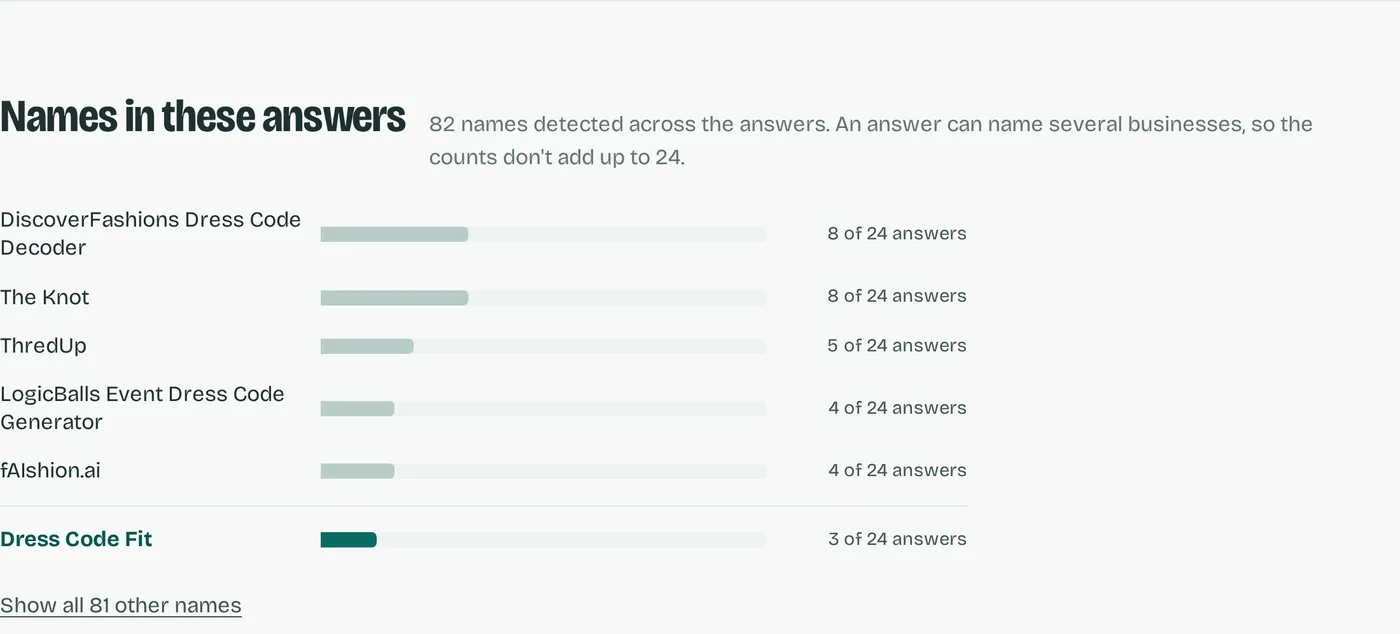
What to check (advice): for the two or three names that come up most, look at what their sites say and where they are listed. Then compare with step 2 and step 5: is the difference in how clearly they describe themselves, or in where they appear?
7. Search visibility is one signal
In our checks, most answers included links to web pages. It is also worth checking whether people can find you in ordinary search for the same topics. CheckAI shows whether you appear in the top 10 Google and Bing results for a few search terms, and at what position, and whether Google showed an AI Overview for them.
We have not measured a reliable link between search position and being named by the assistants, and we don't claim one. Treat it as one signal among several: if you don't appear in the top results for your most obvious search term, that is worth knowing either way.
8. One check can mislead, especially for new or niche businesses
AI answers can vary between runs. One check may therefore give a misleading impression.
Our data When the same question for the same business went to the same assistant again in a later check, the list of named businesses was identical in 0 of 42 pairs. Whether the checked business was named stayed the same in 38 of 42 pairs, mostly because it was not named either time. The guide on why AI answers change goes into this.
A business that is very new, or that serves a very small niche, may also have little written about it yet on other websites. In that case the honest answer may be that it takes time, and that the most useful thing is to make sure the basics in steps 2 and 5 are right.
What to check (advice): repeat the same questions at regular intervals and compare the share of answers that name you over several rounds, rather than reacting to one result. CheckAI's tracking does this weekly or every two weeks and tests whether a change is larger than normal variation; you can also do it by hand with a simple table.
Where to start
If you only have an hour, start with steps 1, 2 and 4: they are about your questions and your own site, and you can fix them yourself. Then look at the sources and the names in your answers (steps 5 and 6). The Single Check on CheckAI shows those two lists for your own questions. Whatever you change, no one can promise that an assistant will name you afterwards; what you can do is make it easier for it to connect your business to the questions your customers ask.